The Kettle Doesn't Care What You Paid: 12 Plug-In Buys Judged by the Meter
A cheap appliance has a nice way of feeling like a win in the shop. It is only later, when the meter has been ticking away for a few weeks, that the real price starts to show. For some household buys the sticker price is almost the whole story. For others it is barely chapter one.
This is not a lecture about switching everything off at the wall. It is a practical way to shop: look at the box, then look past it. Using a round 25p per kWh for easy maths, here are 12 plug-in buys where the running cost deserves a place in the trolley decision.
Start with the meter, not the shelf edge
The basic sum is simple. Take the wattage, divide by 1,000, multiply by the hours you use it, then multiply by your electricity rate. A 2,000W heater on for one hour is 2kWh, or about 50p at 25p per kWh. A 1,500W air fryer running for 20 minutes is roughly 0.5kWh, or about 12p.
That does not tell you everything. A kettle is powerful but brief. A dehumidifier may be modest but run for hours. A tumble dryer might only go on twice a week, but each load is a proper event. The useful question is not 'how many watts?' on its own. It is 'how many watts, for how long, how often?'
What the energy label is good for, and what it is not
Energy labels are handy for comparing two appliances of the same type. They are less handy for predicting your actual bill. A washing machine label is based on a set cycle pattern. A tumble dryer label assumes a certain load. A fridge label assumes a certain room temperature and door-opening habit.
So treat the label as a starting point, not a promise. Check the annual kWh figure where it is given, look at the wattage on the rating plate, and be sceptical of vague 'eco' wording. An eco mode that takes four hours may still be cheaper than a fast mode, but only if you actually use it.
12 plug-in buys where the second price matters
1. Kettles
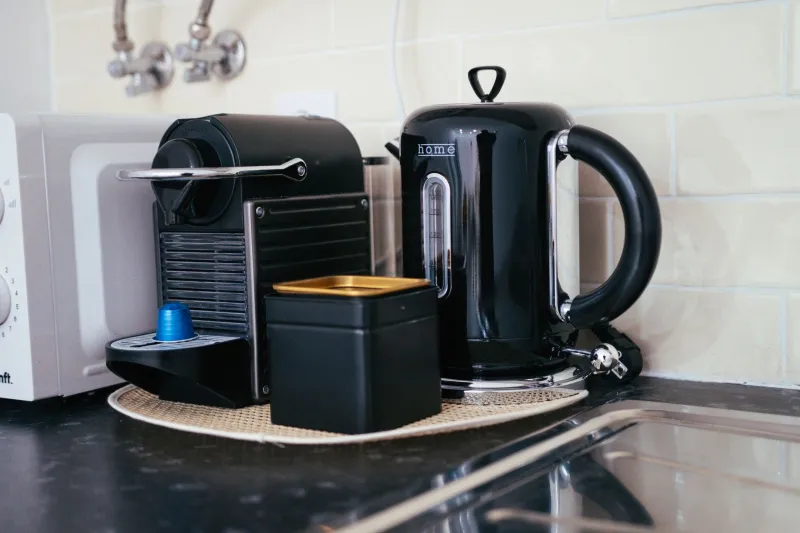
The sticker price barely changes the boiling cost. A cheap kettle and a posh one both use a lot of power for a short time. The bigger savings come from not overfilling, descaling, and only boiling what you need. If you boil a full kettle for one mug several times a day, that habit costs more than the difference between a basic model and a branded one.
2. Air fryers
For a quick tea for two, an air fryer can undercut a big oven because it heats a smaller space for less time. For a full family traybake, the maths can flip. Cheap models with poor circulation may also need longer cooking times, which nibbles away at the advantage. Buy for the portions you actually cook.
3. Heated airers
A heated airer is a good example of a low sticker price hiding a steady running cost. A 300W airer on for five hours is about 1.5kWh, or roughly 38p. That can still be cheaper than a tumble dryer load, but a flimsy cheap airer that needs 10 hours to dry a wash is not the bargain it looks.
4. Dehumidifiers
This is one of the clearest 'pay more upfront' categories. A cheap compressor dehumidifier may be slow to pull water from a cold room, so it runs longer. A desiccant model can work better in cool spaces but often uses more power. Match the extract rate to the room, not just the price tag.
5. Slow cookers
Slow cookers are usually cheap to run because the wattage is low. A 150W cooker on for six hours is about 0.9kWh, or around 22p. The cheap box is often fine here. Do check the keep-warm wattage, though, because leaving it on warm for hours adds up.
6. Electric blankets and throws
A 60W heated throw used for two hours costs about 3p at 25p per kWh. That is a very different proposition from heating a whole room. The upfront price matters less than safety features, a timer, and a washable cover. Buy from a retailer with a proper returns policy and check for the latest safety standard.
7. Panel and halogen heaters
A cheap 2kW heater can cost about 50p an hour. That is fine for a short burst in one room, but it is not a cheap way to heat a house. If a low sticker price tempts you into using one all evening, the running cost will dwarf the saving. Look for thermostats and timers, and use them as spot heating, not a boiler substitute.
8. Tumble dryers
This is where the label earns its keep. A heat-pump dryer usually costs more to buy but uses less energy per load than a vented or condenser model. If you dry several loads a week, the gap can pay back over time. If you barely use a dryer, the cheap box may still be the sensible box.
9. Washing machines
Check the energy label per 100 cycles, then check the eco cycle time. A cheaper machine with a good eco programme can beat a pricier one used on quick washes. Washing at 30C, filling the drum properly, and avoiding unnecessary pre-washes will do more than chasing a fancy dial.
10. Dishwashers
A cheap dishwasher without a decent eco cycle can be a false economy. Eco programmes use less energy, even if they run longer. If you rinse plates under a hot tap first, you are paying twice. Buy for the place settings you need and use the programme that suits the load.
11. Cordless vacuums
Wattage is not the whole story here. A cheap cordless vacuum with a short runtime and a battery that cannot be replaced may cost more over a few years than a slightly dearer model with a sensible battery. Check runtime, filter cost, and whether replacement batteries are available.
12. Mini fridges and drinks coolers
A small undercounter fridge can be handy, but cheap mini fridges are often inefficient for their size. If it runs all day to keep a few cans cold, the running cost can look silly next to the purchase price. Buy one for a genuine need, not because it was £40 in a sale.
Where paying more usually pays back
Heat-pump tumble dryers, well-sized dehumidifiers, and efficient washing machines are the strongest cases for spending a bit more. These are appliances that run often and for long enough that the meter notices. A good energy label plus a sensible size is worth more than a flashy extra feature.
Where the cheap box is often fine
Kettles, slow cookers, and simple electric blankets are less about the label and more about how you use them. A basic model with a timer, a thermostat, or a safe cut-off can be perfectly sensible. Do not pay extra for 'eco' branding alone.
The three checks before you pay
First, find the wattage or annual kWh. Second, estimate how often you will really use it. Third, ask whether a cheaper model will need to run longer to do the same job. If the answer is yes, that cheap box may not be cheap at all.
The best deal is not always the lowest shelf price. It is the one that does the job without quietly charging you again every evening.